
Why More Parents Are Choosing IB PYP for Their Children’s Early Education
BY ADMIN PUBLISHED June 25, 2025, UPDATED June 25, 2025
“Education is the kindling of a flame, not the filling of a vessel.”– Socrates
Over the years, the true meaning of education has undergone a profound transformation— a metamorphosis where it is no longer confined to the four walls of the classroom or the pages of a book and is redefining how young minds engage with the world. And there’s no place where this change is more impactful than in primary education. These are the formative years—between the ages of 3 and 12—when a child's mind is most impressionable. What they see, absorb, and experience during this time forms the foundation for lifelong learning and character development.
Parents today are becoming increasingly intentional about the kind of education they choose for their children, especially during the early, formative years. They consistently prioritize schools that implement an activity-based approach to primary education, as it enables children to learn through active engagement while developing crucial motor and life skills.
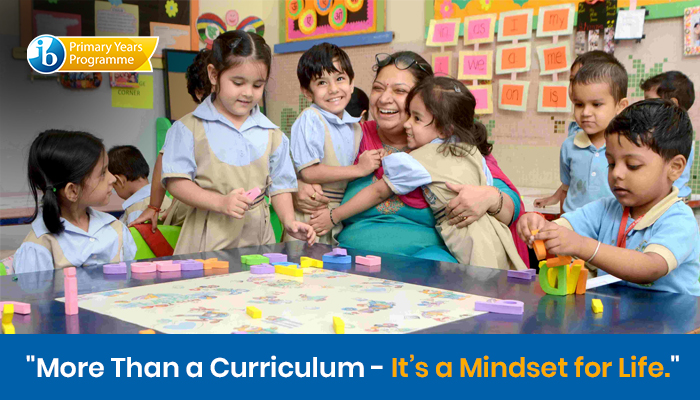
One approach leading this wave of change is the International Baccalaureate Primary Years Programme (IB PYP). Celebrated by educators and embraced by parents, IB PYP is not just a curriculum, it’s a philosophy that nurtures inquisitive, lifelong learners ready to thrive in an ever-evolving world. In essence, the IB PYP doesn’t just prepare students for school—it prepares them for life.
What makes IB PYP a preferred choice for parents?
Here are some of the key reasons why more and more parents are opting for the IB Primary Years Programme for their children’s early education:
1. It nurtures the whole child
With its transdisciplinary approach, the IB Primary Years Programme (IB PYP) is designed to develop a child’s intellectual, social, emotional, and physical well-being. It's not just about ticking boxes or memorizing facts—it's about nurturing the whole child. The aim is to raise curious, confident, and compassionate learners who are prepared for life, not just exams.
2. Learning through inquiry
At the heart of IB PYP is inquiry-based learning, where children are encouraged to ask questions, seek answers, and make connections. This “learning by doing” approach makes education more engaging, relevant, and exciting for young learners.
3. Skills that matter for life
Through engaging projects and real-life applications, they naturally develop key skills like critical thinking, communication, collaboration, research, and self-management—skills that will serve them not just in school, but in life.
4. Creativity meets structure
With a transdisciplinary approach, students explore big ideas across subjects, blending science, art, language, and more. This creative freedom, combined with structured inquiry, allows children to discover their passions and strengths during their early years.
5. A global mindset from the start
Being an international program, the IB PYP instills a global perspective in children. Students are introduced to real-world situations, widen their viewpoints, and understand their role as citizens of the world, skills that are becoming essential in today’s global society.
6. A foundation for lifelong learning
IB PYP promotes a genuine love for learning. It encourages students to be curious, courageous, and committed, all of which are qualities that are essential for thriving in a fast-changing world.
In Conclusion
Choosing the right primary education is one of the most important decisions a parent can make for a child. And for many families, it’s the first and most important step toward a lifelong adventure in learning.
DPSG Vasundhara is one of the best schools in Ghaziabad that offers IB PYP curriculum promising a future-focused, holistic, and enriching foundation, one that not only prepares children for academic success but also empowers them to become thoughtful, capable, and compassionate individuals. For us, the IB PYP isn’t just a curriculum—it’s a transformational journey.
For more information, click here

