
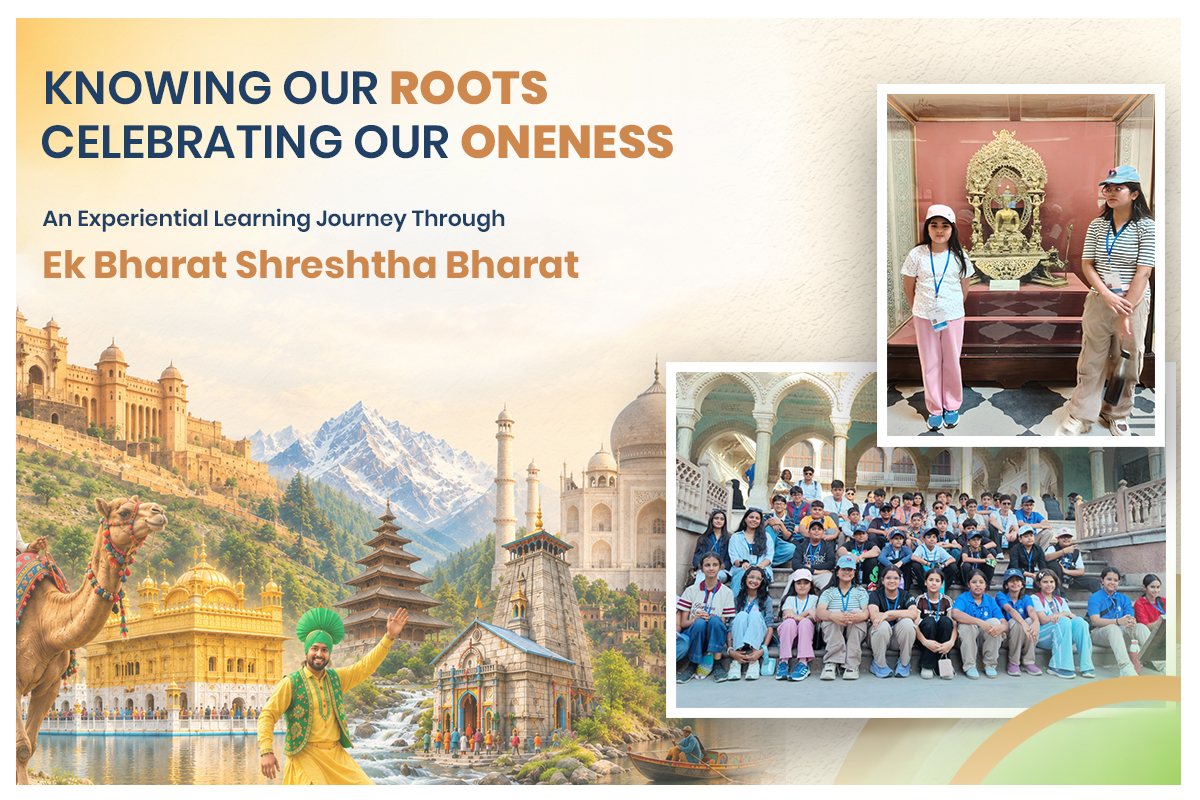
Ek Bharat Shreshtha Bharat(EBSB): Knowing Our Roots, Celebrating Our Oneness
BY ADMIN PUBLISHED October 8, 2026, UPDATED January 1, 1970
What does it truly mean to know our country? Is it enough to know the names of its states, remember their capitals or locate them on a map?
I believe it is much more. To know our country is to know its people, stories, traditions, languages, food, art and the values that have travelled across generations. It is to understand the many threads that together weave the beautiful fabric of our Bharatiyata. At DPSG, we have brought this vision into our students' learning journey, making it experiential, purposeful, and deeply personal.
The EBSB initiative seeks to strengthen mutual understanding and emotional bonds between people across states and regions by encouraging meaningful engagement with their languages, culture, traditions, cuisine, heritage and ways of life.
This year, our students have travelled to Rajasthan, Punjab, Himachal Pradesh and Uttarakhand, not simply as tourists, but as curious learners. Their journey began much before they boarded their buses. Through research and preparation, they explored the geography, history, heritage, culture, governance, economy, environment and contemporary life of their chosen states. The learning cycle moves from research and language learning to travel, reflection and sharing.
And this is precisely why EBSB matters.
I often think of our country as we think of a family. In a family, relationships become stronger when we know one another. A child who knows only the name of a parent knows very little about that parent. But when the child learns about the struggles, sacrifices, dreams, traditions and achievements of the family, a deeper bond begins to develop. Knowing creates understanding, understanding creates respect and respect creates belonging.
The same is true of our country.
Our children should not grow up knowing India only through textbooks. They should hear its languages, taste its cuisines, experience its traditions, meet its people, walk through its history and understand the lives that shape its present. They should discover that a folk song from Punjab, the crafts of Rajasthan, the traditions of Himachal Pradesh or the spiritual and ecological heritage of Uttarakhand may appear different, yet each contributes to the larger story of who we are.
The ten learning lenses of EBSB help students see each state in its wholeness rather than through a few familiar landmarks. They look at geography, history and heritage, society, culture and traditions, governance, economy, infrastructure, education and development, sustainability and current affairs.
For me, the greatest outcome of EBSB is therefore not the number of places visited. It is the sense of belonging that grows within a child.
When a student returns with a new appreciation for another region, a new word from another language, a new respect for a tradition or a story that has touched the heart, learning has moved beyond the classroom.
That is when Bharatiyata becomes real.
We hope that every student returns not merely with photographs and memories, but with a wider heart, a deeper respect for diversity and a stronger understanding of the beautiful truth that we may speak differently, eat differently, dress differently and celebrate differently, yet we belong to one shared national story. It is not only about discovering different states, It is about discovering ourselves through them.
If EBSB can leave our children with one enduring thought, let it be this: there is always more to discover, more to understand and more to appreciate about the land we call home, our BHARAT.
Thanks
Ms. Priti Wason
Principal