
Beyond the Textbook: Discovering India Through Ek Bharat Shreshtha Bharat
BY ADMIN PUBLISHED October 6, 2026, UPDATED October 8, 2026
Quick question: what does Kerala taste like? How does Assamese sound? For most students, the answer comes from a textbook, a few lines about a state's food, festivals and language, read once and remembered until the exam. Textbooks are a valuable place to start, but real understanding of a country as vast and varied as India rarely begins on a page. It begins when students step out, look around and experience it for themselves.
That belief sits at the heart of Ek Bharat Shreshtha Bharat (EBSB), a Government of India initiative launched on Rashtriya Ekta Diwas, 31 October 2015. India holds countless stories within its borders, in the languages we speak, the food we cook, the festivals we celebrate and the landscapes we call home. Rather than seeing this variety as something that sets us apart, EBSB treats it as a reason to come closer. The initiative pairs States and Union Territories so that people can discover one another's culture through language, literature, music, cuisine, sport, tourism and everyday traditions. The idea behind it is simple yet powerful: we understand our country better when we understand each other better.
In schools, EBSB has encouraged students to explore the customs, languages, art and heritage of states other than their own, and even to pick up a few words of a language they may never have heard at home. These are meaningful steps towards linguistic awareness and mutual respect. Yet there is only so much a classroom can offer. A textbook can describe a region, but a journey lets a student step into it. When young people walk through a historic site, hear a new dialect at a local market, share a regional meal or watch a tradition unfold right in front of them, India stops being a set of chapters to memorise. It becomes a living, connected country they have seen with their own eyes.
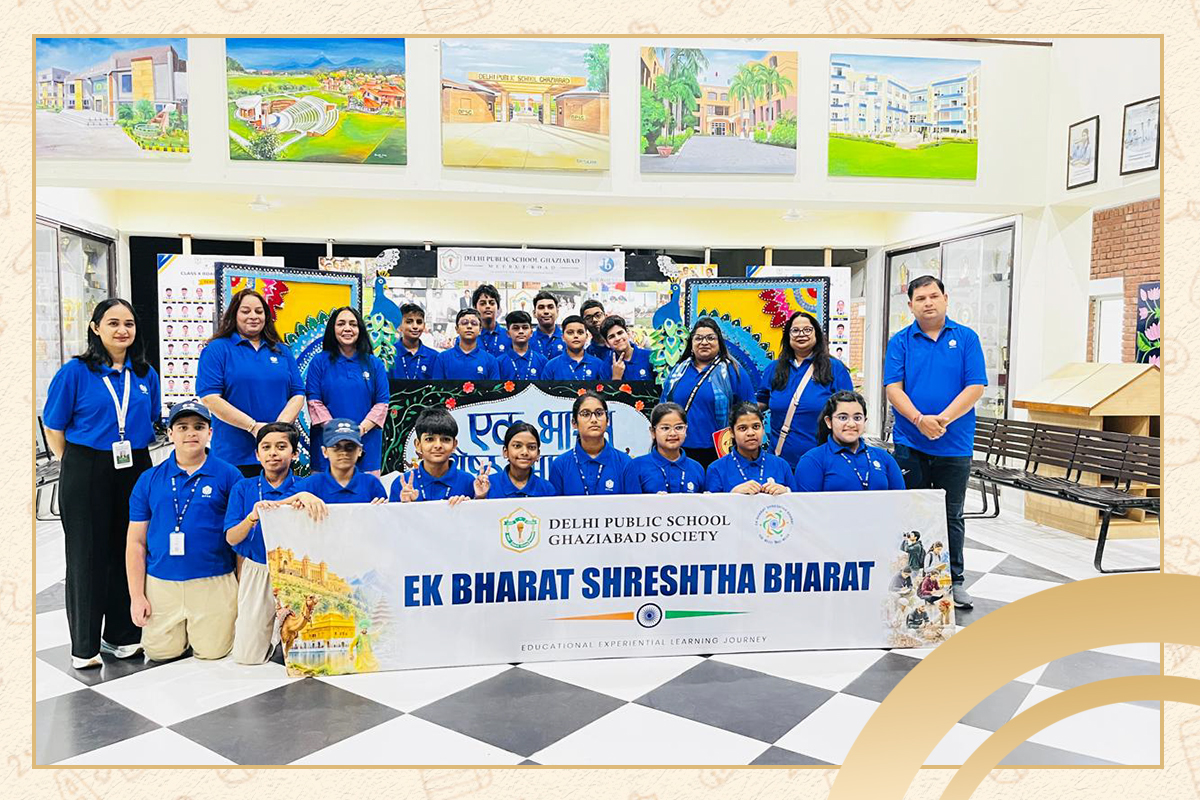
This is the thinking behind the Educational Experiential Learning Journey at Delhi Public School Ghaziabad. Over 8 days, students from Grades 6 to 12 travel across 5 states, and every stop along the way becomes a lesson. History comes alive at a monument, geography takes shape in the changing landscape outside the window, language is heard in everyday conversation and culture is discovered through the people who live it. It is, quite simply, a classroom without walls.
The journey builds far more than knowledge. It nurtures curiosity, adaptability, sharp observation and empathy. Students learn to ask better questions, settle into unfamiliar surroundings and respect points of view that are different from their own. Learning becomes something they take part in rather than something they simply receive, and the lessons stay with them long after they return home. This approach also reflects the direction set by the National Education Policy 2020, which calls for learning that is experiential, holistic and multidisciplinary. EBSB gives schools a natural way to put these ideas into practice, linking what students study in class with the culture, travel and real-world encounters that give it meaning.
Perhaps the most important lesson EBSB offers is that unity does not require sameness. India does not hold together because its people are alike; it holds together because they are able to live alongside, and learn from, those who are different. For schools, this sets a meaningful task: helping students see that the India beyond their own neighbourhood is not a distant place, but another chapter of the same story. Through the Educational Experiential Learning Journey, DPS Ghaziabad invites its students to read that story first-hand, one state, one conversation and one discovery at a time.